Interview with BOD Contributor: Grace Mitchell
their time in Oklahoma on a sheep farm, their residency, and making art as an act of devotion. February 2026

Grace Mitchell is an artist living in Milwaukee, Wisconsin. She works primarily in film, fiber, and poetics.
Grace has taught Personal Cinema, Nonfiction Filmmaking, Approaches to Making: Time-Based, and other conceptual, professional, and studio-based courses at University of Wisconsin–Milwaukee and Milwaukee Institute of Art & Design. She has also led an intarsia knitting workshop at Driftless Folk School in southwest Wisconsin and Hand Spun Art Yarn as part of the Being Other Dust series using locally sourced wool from Brown Dog Farm.
In pursuit of her interest in wool, sheep, and her shepherding ancestors, Grace earned an animal husbandry certification through a summer internship on a sheep farm and wool mill in Oklahoma. She currently works as a documentary video editor.
Being Other Dust is a collaborative workshop series exploring topics including folk herbalism, divination, animism, queer theory and intersectional feminism with additional guest artists.
Project support provided by The Open Fund, through the Poor Farm with funding from The Andy Warhol Foundation for the Visual Arts and Ruth Foundation for the Arts.
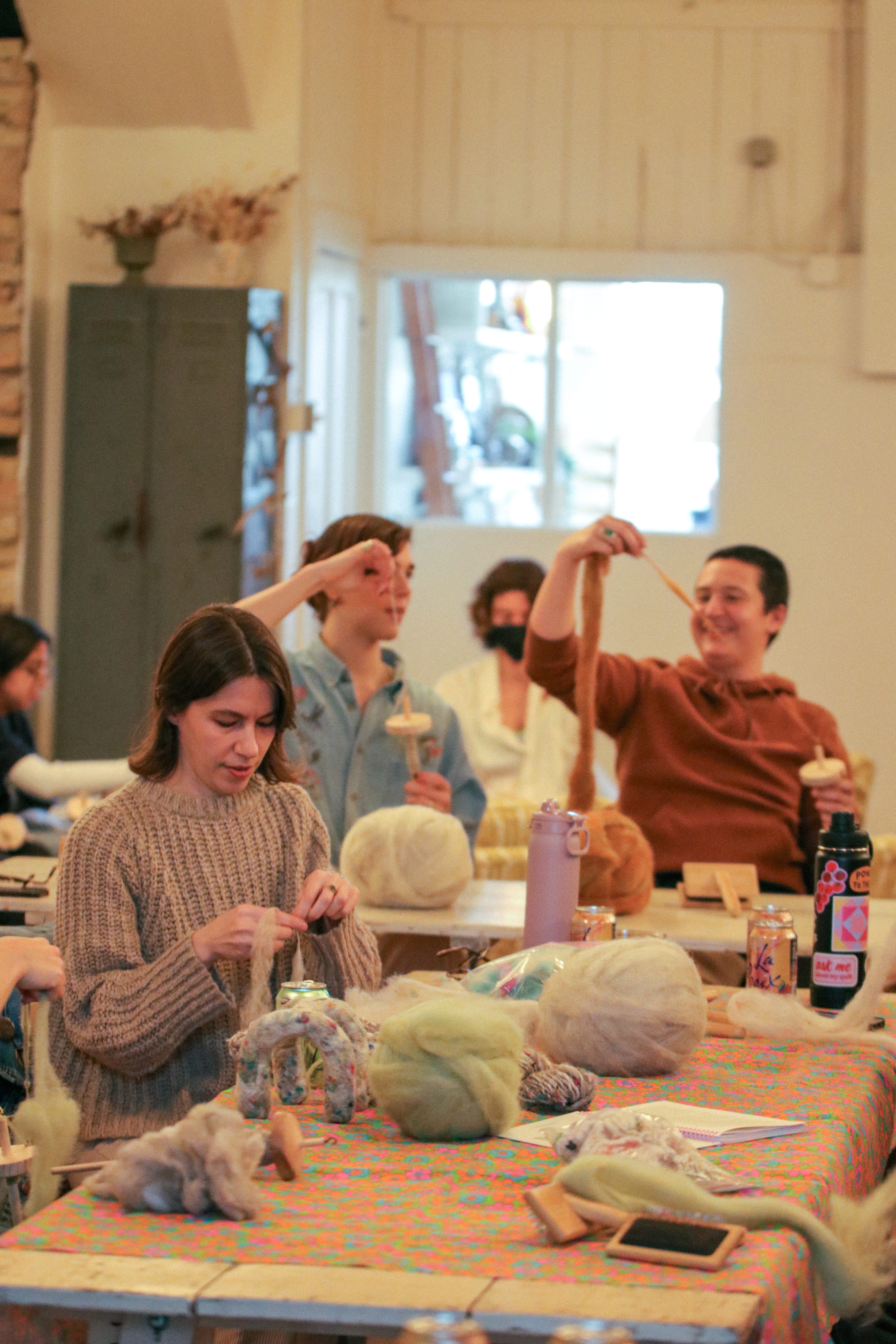
Being Other Dust launched in the fall of 2024 with Grace Mitchell’s workshop on spinning “art yarn”. The following interview is between Grace and Kayle (facilitator of B.O.D.) from February 2026.
Kayle: I would love to hear you talk about how and why you started knitting. However in-depth and raw you want to get with that, and then also I feel like you often talk about this interest in sort of your family’s history with being shepherds and the agricultural farm people.
Grace: Yeah, totally. All of that. I knew that my family on my dad’s side were farmers. My great-grandfather moved here from Scotland, and he moved to Minnesota, I think, from Scotland, as a shepherd. So there’s the shepherding that goes back, and they were from Inverness, Scotland– really rural farmland in Scotland. And then they moved here and became farmers. I don’t know the extent to which—I know they were working with livestock, but I don’t know if it broadened from just sheep to other things. And then my grandfather continued agriculture, but then halfway through his life, he shifted over to factory work at Hormel, which made Spam. So he became a factory worker and that’s how he supported his family because farming was less and less of a viable option, just industrialization and everything. And then, yeah, my dad was then exited from agriculture.
But I think that unlike my father, I’ve always been really drawn to that (farm-life). Or I don’t know how drawn I’ve been to it, but I’m really curious about it. Where my dad, I think, saw it differently. And had my dad been a farmer, perhaps I’d see it very differently, to be honest. I think if I was raised as a farm girl, I might have fucking hated it. So I think there’s the choice of the matter that makes it appealing… Honestly, I’ve been drawn to it since I’ve been doing fiber stuff and knitting. I think I’ve just been thinking about that and then had the idea– “Oh, it makes sense. I’m so addicted to knitting because my great-grandfather was a shepherd.”
Kayle: Right. I feel like we’ve talked about this a little bit here and there, but it feels like it’s in your DNA in a really real way.
Grace: Yeah, for sure. Well, I think I wanted to test that theory by actually farming and working with livestock because I think it was like, yes, I feel it, but I wanted to actually know and to feel it in that way. And so that’s when I started researching places that were sheep farms and wool mills because I wanted the experience of farming and the textile creation as well. So that’s why I landed up in Oklahoma, because it was the only one I could find that had both of those things and provided an internship opportunity.
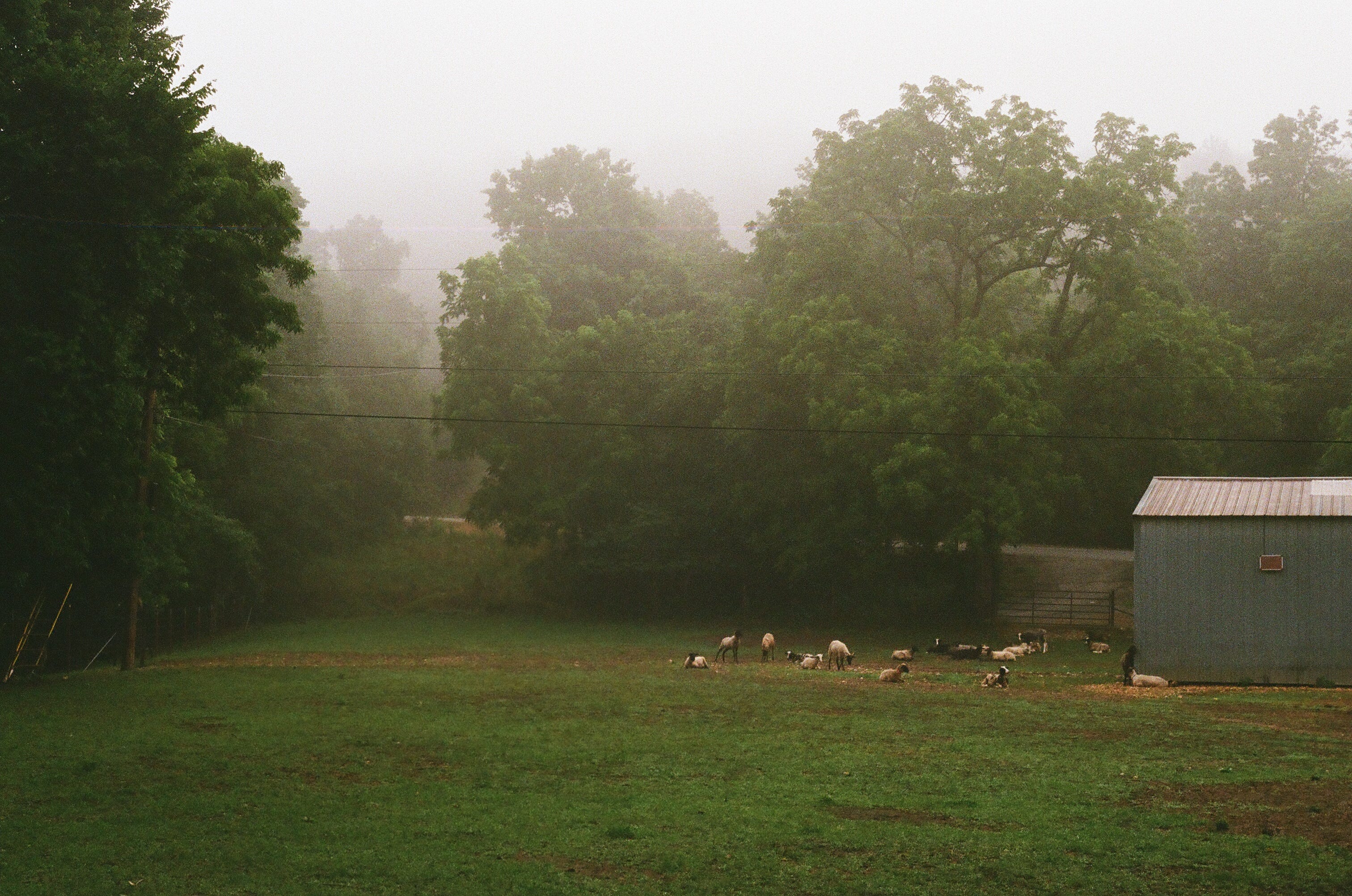
Kayle: So there was a bit of this experiment of being interested in this idea: can the things that our not-so-distant ancestors did, or even very distant ancestors did, live on in our bodies? And is there this ability for it to activate or something when we start partaking in the things that we know that they did? But then also you were like, “I don’t know, is this a new career path for me?” And also you were like—is it a career path but also like lifestyle—”Do I, after this, want to buy land in the Driftless region and have a sheep farm” You were like at one point, “Yeah, that’s what I want to do,” and then you got back from Oklahoma and you were like, “Fuck that. I do not want to do that. I want to be able to go to live music on a Thursday night.”
Grace: Yeah, honestly, like I missed live music so much. [laughs]
Kayle: Sure. We love live music. [laughing]
Grace: Yeah, I just love live music. [laughing] And also the live music that would be in the country is not what I’m talking about. I need indie, live indie music.
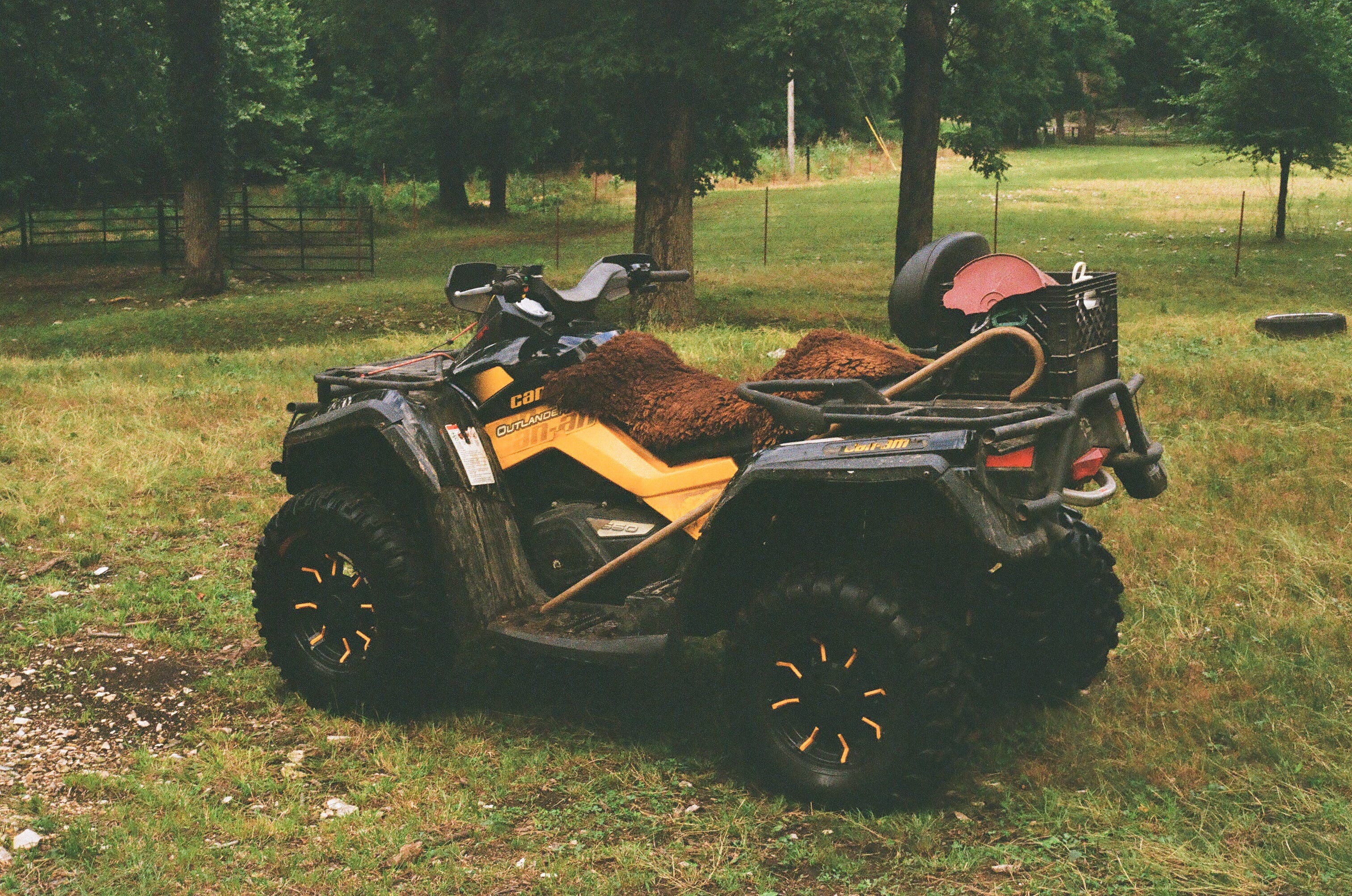
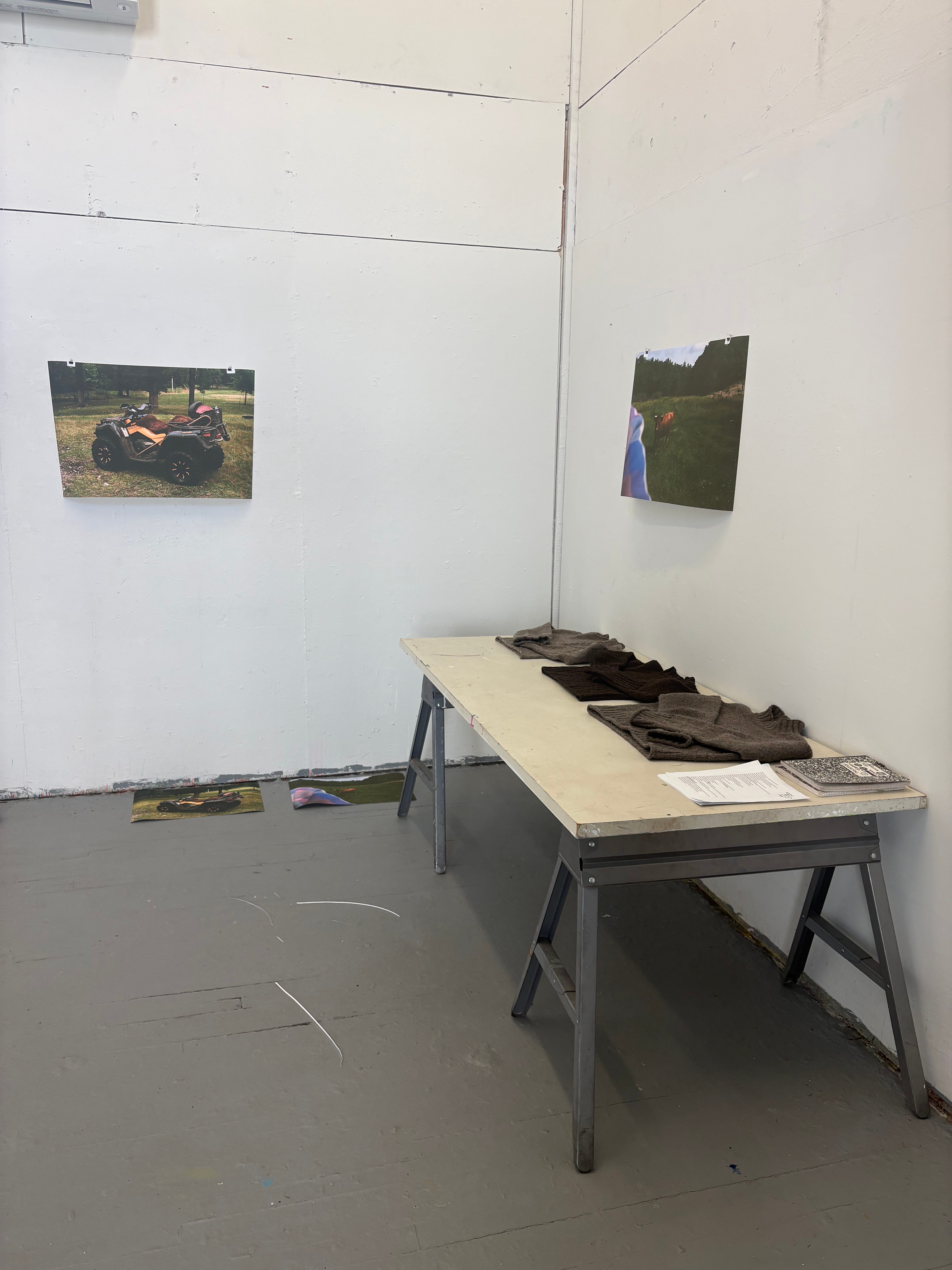
But yeah. Honestly, on the farm, I was really unhappy a lot of the time. I really struggled. And I loved working with the animals, but the surrounding culture was really hard. And also this idea of... a farm is a living, breathing organism that you can’t leave alone. Fucking freaked me out. So, it’s funny looking at this and talking about it with people while at an art residency because everyone’s like this Americana—it’s just becoming artified so fast.
And it’s kind of weirding me out because I feel like I’m exploiting the situation or—I don’t know if “exploiting” is the right word—but it feels like it’s taking on a reality of its own that through the lens of the art world is being like, “Oh, it’s like an Ethel Cain album art,” you know what I mean? Backwoods Ozark shit. It’s like, “Oh yeah, this is speaking to... there’s a visual language that this is speaking to.” And how do I want to contend with that as an artist?
Kayle: Okay, this is something that I want to explode out and talk more about. Because when I was just on my recent residency I went to hang out with a friend of a friend– we had a friend in common that was like, “You two need to meet.” So we had coffee and immediately hit it off and started sharing with each other what we do, our past experiences as artists etc. We got to talking about school because we’re both teachers and it turns out this friend went to this very prestigious grad program and she was basically like, “Yeah, I did that. It was all of these things, got my MFA and I fucking hated everything I made. I was super depressed, super anxious, and I was like, ‘Fuck it, I’m gonna move to the desert,’” and is now living her best art-witch life. And we were talking about how making art is a spiritual endeavor, no matter how much you try to academicify it. And then I would go back to the residency and people would be like, “What are you doing?” And I would be like, “Yeah, I made this hair suit based off of these medieval images of Mary Magdalene,” and talking about that. And they were all kind of like, “Crazy. Cool.” They would try and talk about it in the context and ways in which we’ve been trained to talk about art and I just felt my soul—metaphorically and literally, just like, leave my body. I would disassociate.
Grace: Right, like, how do you make peace with something that you see as a spiritual practice?
And my whole time in Oklahoma was extremely that. In the book it goes into it too—this thing that’s happening in my body when I’m there, and the discomfort, and then these deeper levels of experience happening.
But now I’m having to be like, “Okay, I also need to serve this work.”
And serving this work also means bringing it into different realms.
Kayle: So then we’re like okay, why bring it into the art context?
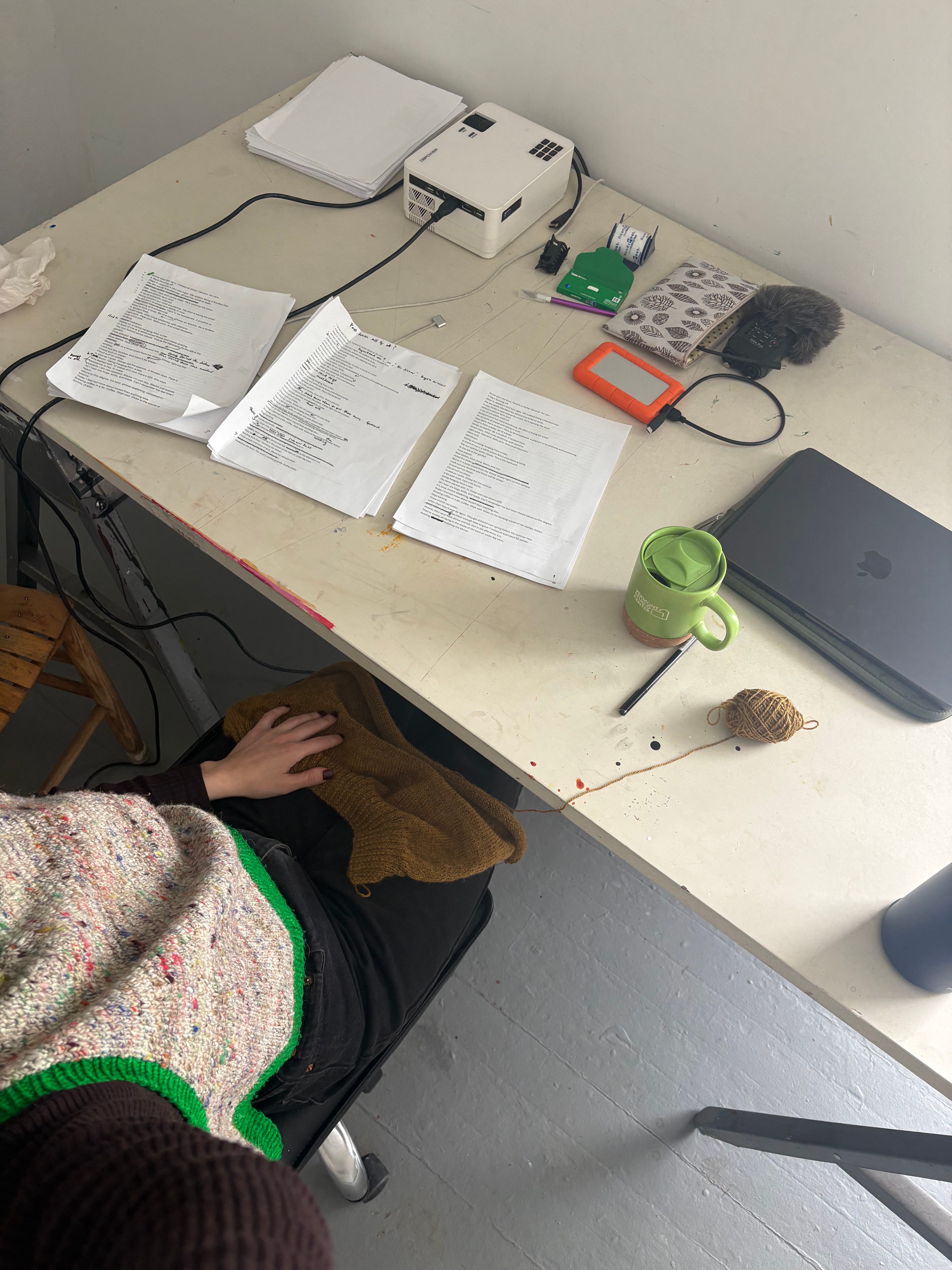
Grace: Right. And how do you service your art as best you can without degrading it or degrading yourself? And what part of you is just ego that’s upset and what parts of it is actually having integrity when making the art? I think that’s where I’m at right now with it, where I’m like, “I want to show it and I want it to be amazing, but I also need it to stay preserved in some way.”
It’s a little anxiety-inducing—do I self-publish a book or find a small press, or DIY? It’s just kind of hard. The spiritual part is actually the smaller part of it in the sharing of it.
Kayle: Wait, what do you mean by that?
Grace: I mean, when I think about having this show and book and doing the work for a show and doing the work and getting a book published... or maybe I need to reframe it where that is being a servant to the work. And that is also part of the spiritual practice. I should reframe how I’m looking at it.
Because I think something I learned on the farm, and something that they said, which is religious, but they’re like, “having a servant heart.” And I guess I’m interpreting that to be like we’re receivers on some level.
To give justice to what I am serving also includes the things that I don’t want to do, much like taking care of sheep—I don’t want to clean shit off of sheep’s tails, but if I don’t, they’re going to get maggots. So it’s like, I don’t want to write a grant or propose a show, but I also need people to see this for some reason. I don’t know. That’s a weird side tangent that I’ve been grappling with in terms of personal and professional life while I’ve been at this residency.
Kayle: Yeah I think that makes sense. So we haven’t used the word vulnerability here, but I think when you’re talking about ego, that’s a big part of it, right? Not that it needs to be black and white like this but it’s easier to make work that is highly academic and in the way that we have been trained to make art, where it’s very referential of theory and xyz, because that’s the norm in the contemporary art world and that’s what we’re trained to do. So this being maybe a little bit more driven by intuition.
When I’m saying it’s “intuitive” or “spiritual” I’m think about it like, here’s a feeling inside of my body that draws me to certain content or certain ideas or certain ways of making. And I’m like, “Okay, I hear you and I’m going to go towards that.” Which has only been possible through a lot of unlearning and relearning my relationship to making and how I think about my practice.
I don’t know, I’m just kind of going off, but I think that vulnerability is a huge component to what we’re talking about. And I really appreciate that you’re bringing up this idea of being in service to these ideas or the work– our subject matter essentially. And part of this draw for you is like, “this story needs to be told.”
Grace: I’ve been thinking about that a lot and how the book component—it’s really not even about sheep, even though sheep are in the foreground the whole time. It’s about connection of people, connection to the land, connection to self through all of these things. And that’s also how I feel about knitting. It’s like, yeah, it’s knitting, but that’s actually about so much more than that. It’s about connection– using your hands to make something that you can wear. It’s about the people that it draws you to, the community that surrounds it.
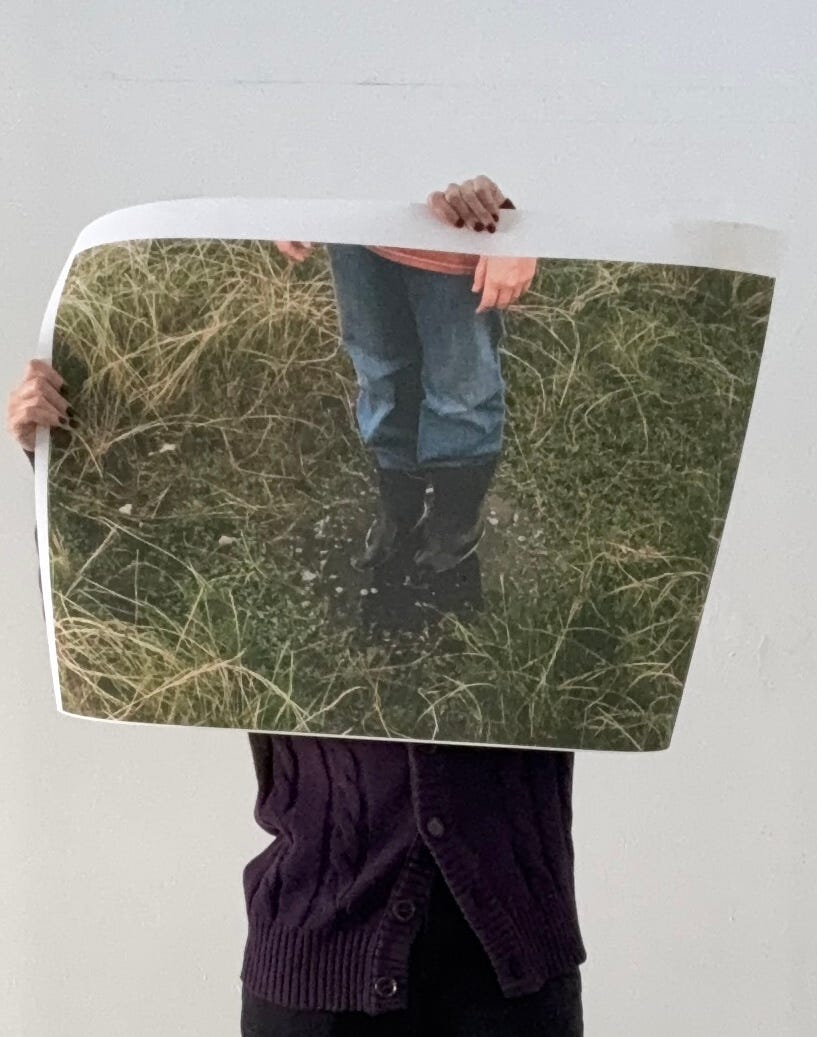
I feel that way about the other components too, like the visual language I’m working in. I want it to feel like it’s a thing you can step into or take something out of, and it doesn’t really matter if you know where it is or not. I want it to speak to something; I want it to be tapping into something a little bit deeper than that. So yeah, I want it to be a little bit beyond, or maybe I want to be beyond landscape, but trying to bridge what landscape is on the outside to all of these things as well.
Kayle: A thought that came into my mind when you were saying “it doesn’t matter if you know where it is” that I think is pretty integral to the ethos of a folk practice or anything that uses that terminology of folk or tradition– there’s something inherent to it that might exist in a lot of different spaces. There’s something—I think actually maybe not so elemental, but human—like animal husbandry is something that exists in many cultures at various points in time. And so, in some ways it’s similar to the thing we were talking about with your family having a history of being shepherds, but at this more collective scale. And what does it mean to tap into that in an art context?
Grace: Yep, exactly. So it’s kind of like the endeavor, which both does have words and has no words, and that being an important part too, I think. But yeah, I’m really excited by it, which is better than some feelings I’ve gotten from other projects that feel like such a slog. I feel like in this project, I’ve learned the difference between doing something for something a bit more egotistical, like approval or relevance or validity, and I feel like I’m doing this more out of a deeper rooted desire to connect. A rooted desire to discover something and reveal things to myself, and have things be revealed to me through trust and through having guts, and through avenues that are outside of maybe some more conventional institutional ways of creating art.
I think that’s been the most rewarding part—feeling the support that is just trusting yourself. I feel that support system growing more than I have with anything else I’ve made, and so there’s just the signs that are like, “Yes,” and, “Keep going.” That’s extremely important as an artist, to feel and to follow that. And that sometimes might lead someone into a more academic setting, but it might lead some people out of that. And it’s exciting.
Kayle: Yes! That’s really the nugget that I’ve been taking away the most.
Grace: I’m also interested in a practice when you feel an absence of yourself. I think I’ve been feeling this in all the components, but when I feel like someone else wrote that, or something else came through when the photograph was taken—that to me feels really good in this way where it feels more collaborative.
Not collaborative with an actual person, but collaborative with something closer to an entity or something closer to maybe ancestral or environmental. By devoting yourself to something, you’re getting something in return. Being devotional is also a way to receive sustenance on a creative level. I find that as I get older, being devoted is the only way to go. How else would you make something unless you’re devoting yourself to it?
Kayle: Hell yeah.
Kayle: One way that I might try to articulate that and how I felt it is that these moments of devotion, when you know you’re feeling it, it’s this actual collapsing of the space between you and the things around you or you and the ideas. It’s like it’s all one; you somehow feel like it’s all one thing as you’re snapping the photo or whatever.
Grace: Yeah, I like that. I I write about this in the book—for context, the book I’m writing comes from two composition journals I filled up while I was in Oklahoma and I tried to essentially channel the land in every journal entry. This was the closest I’ve tried to be to channeling. And there’s a part in the book about “casual devotion” and that, like, why not assign magical qualities to things? Why not see magic as a highly accessible thing? And why not be devoted in this way that’s casual? I think I’m still teasing out what that means—this idea of devotion being this extremely integrated-into-life action.
Kayle: Yeah. Instead of having to go somewhere or do something specific to be devotional, it just is the way that you’re operating.
Grace: Exactly. To operate from a lens of devotion. And then everything you’re doing is ritualistic in a way, or everything you’re doing has magical qualities. And then if you’re moving through life in that way, the art isn’t a separate thing. The action that you’re doing is artful.
I was reading a lot of Sister Corita while I was on the farm, and she’s very much so that lens. She’s like, “How you do your chores is art.” Like, “There is only make,” and these other axioms that I was really drawn to. And also really separating the critical lens from the creative lens. Let those be separate things– just delete the critic in your head because that person is holding you back from tapping in. And that’s because that voice is so human; it’s not allowing you to go beyond human into other realms that you need to go to to find that source.
Kayle: Wait, who is Sister Corita?
Grace: She was a pop artist screen printer in the 60s and 70s, but she was a nun and she was a teacher. She’s such a badass. She’s the one that refers to Mother Mary as the “juiciest tomato.” [laughs]
Kayle: Hell yeah. I’m Sister Corita-pilled immediately. [laughing]
Grace: And she’s really into her nunnery being a devoted artist. It’s not about good or bad, it’s about “make.” She also coined the term “plork,” which is play and work. I’m going to be like, “I’m plorking,” and I’m going to play and work. But I think I really like her because it’s made me feel like I can take on some of the qualities of religion, like being a disciple or being devoted, but it’s to art—capital A art.
It’s like I’m taking all my self-doubt out of the equation and all the negative self-speak, because none of those things matter. Because I’m just like, “I’m a disciple. That’s what I do.” And those voices have nothing to do with being devoted. If anything, those voices are a little bit—however you want to call it—the Devil. The Devil’s just trying to find its way in, you know?
Kayle: Hell yeah, dude.
Grace: And a lot of it is through that talk. This sounds crazy [laughs], but a lot of that “Devil talk” is what has been utilized in art schools as seen as powerful and authoritative. And then we walk around with that voice in our head and it’s actually like a super neglectful voice and it’s really unkind and untrue. And so, yeah, I guess that’s partly why I’m so into thinking about rearranging religious terms; it’s because it’s helping me reframe my lens from a more—I don’t know, I guess I’m just changing terminology.
Kayle: Well, I mean, it’s—I think—largely puritanical.
Grace: Yes, definitely. I was like, I know you’ll be able to get that. [laughs] And you do that also. I feel like so much of your practice is about actively shifting that in a really visible way.
Kayle: Totally. And I mean, part of that is because I’m just like— for example: I love researching and being like, “Why do we think this way?” And then I end up getting obsessed with medieval depictions of Mary Magdalene covered in hair.
But what you were talking about—the way that you were talking about this idea of the Devil— that’s exactly how I think about and describe The Devil card in Tarot.
Grace: Okay wait, go on.
Kayle: Well, The Devil card is about the ways that you tell yourself or that you essentially censor yourself. When the Devil card comes up, it’s this opportunity to reassess those things.
Grace: Okay, so... alright, alright, alright. There’s four times in the book where I do a tarot pull, and it’s not really talked about, it’s just there. Can I read you an excerpt?
Kayle: Absolutely!
Grace: [reads excerpt:]
Two sickly lambs are off by themselves.
Dog in the distance. The highway hum.
Puddle on the gravel road smells like it’d kill you if you drank it.
From this angle it reflects the sky. Mosquito lands on hand as I write this.
Everyday I say I’ll start meditating.
The mosquitos are getting worse. Air smells like dirt.
Tomorrow is saturday again. The carousel of time. The angels that you ride.
Getting buggier all the time. Itches on my rashes.
9 of Cups
4 of Pentacles
Page of Wands
The Devil
What does it mean to describe something?
It’s Friday and I’m in my pajamas. Nick’s shirt and my underwear.
Is this meditation, or the opposite?
Woke up to thunder.
Reapplied hydrocortisone to my rash and new mosquito bites.
Allowed myself to itch one but now it’s lathered.
Jasmine and I are seeing the same lightning.
Rain is light and sporadic.
Thought I had more to say. I have to pee.
Peed in the sink because the bathroom’s downstairs.
Raining slightly harder now.
Ceiling fan above me whirs.
Humidity making hair poofy.
Found a deer tick on my neck. Filled with my blood.
Now I feel bugs crawling all over me.
Last night I pulled The Devil card. It freaked me out. Everything feels so superstitious.
Kayle says the card is about accepting parts of yourself that you’re ashamed of.
To accept all parts of yourself.
Morning still but later. Weeded. Watered.
Pushed a car out of the mud. Got covered in mud. Dripping in it.
Mud in my hair, on my face. Mud on my glasses, socks, and boots.
Must admit it felt good to get covered in mud, sprayed with it while pushing.
Next time I’ll know where to stand.
…
And so I feel like that’s funny that it made its way in. But yeah, I think about that too. And that actually—and I feel like this is therapy speak—but to send that voice love. To actually care for that voice. I guess there’s this fine balance of when to delete that voice and when to be like, “Oh, let me give you a hug.”
Kayle: Yeah, absolutely. It’s heavy on my mind too because this is my Devil card year.
…
Grace: Should we both pull a card? I brought my deck with me.
Kayle: Okay, I love this. This is great. I’m glad—I was wanting to and I’m glad it made sense to work it in.
[shuffling and pulling of cards]
Kayle: Okay. Should we—let’s flip them to the camera.
Grace: Okay. Ready?
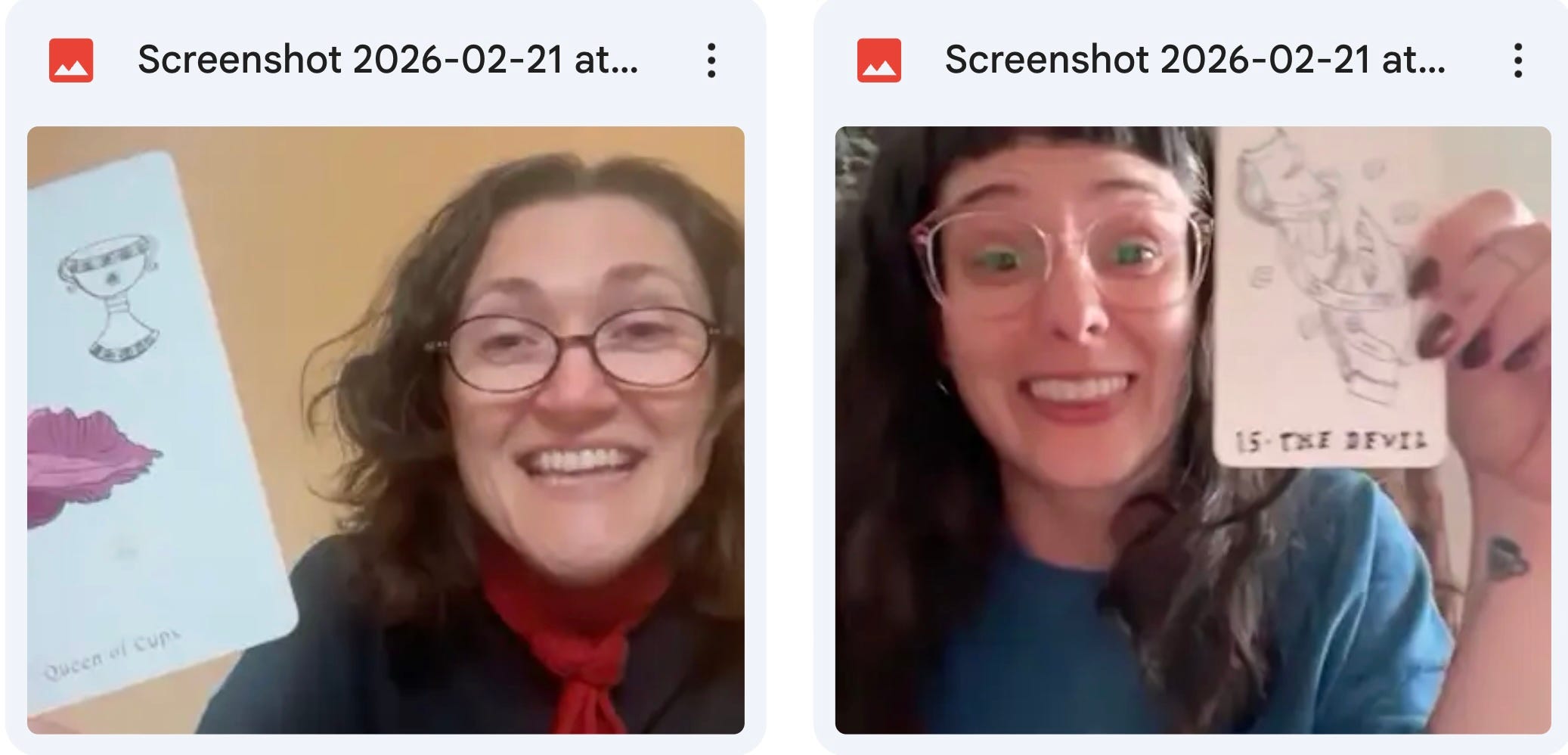
[they both flip cards and immediately start laughing]
Grace: You literally got the Devil? Fuck, that’s crazy.
Kayle: That’s insane. These are the moments where it’s like, “Okay, this shit is real.”
Grace: That’s insane. What did I get?
Kayle: Queen of Cups. I really like these two together.
Grace: What are you picking up on?
Kayle: Well, one way that I learned tarot that I use a lot is that the minor cards are something to do with what you’re actively engaging with or meant to engage with now. The major cards are an energy that you have to have some sort of surrender to. And the court cards are a way of being to embody. And so the Queen of Cups is this ultimate—I think about it as this pretty ultimate vulnerability because the queens are watery and then cups is water. It’s this very emotional, intuitive way of being. In that rendering of it too, you have this woman outstretched in this very labia-esque shell thing. And in the background, there’s a woman riding a fish with a scythe. A reaper. That’s pretty fucking intense. Which, yeah, that woman riding a fish with a scythe feels very Devil card to me. For sure.
Grace: It also reminds me of—this is just really vibing off it and being extremely myopic—but it reminds me of at first a staff. And shepherd shit with that animal-human relationship with a tool.
Kayle: Totally. But yeah, I’m really into it. I mean, I think it’s totally fair to say that a scythe is the plant equivalent of a staff, you know?
Grace: Yeah. A blade doesn’t kill. Staff doesn’t kill.
Grace: Yeah. Right. But you’re bringing it to you. Yes. And the shape of it.
Kayle: Yeah, yeah. Instead of surrendering to the energy of telling us how to be and what to do, we’re kind of seeking and pulling out this very truthful sense of self that we’ve been cultured to sort of push down. And the Queen of Cups is like a way to embody that, right? So it’s this heavy vulnerability and feeling into ourselves—our intuitive, emotional selves—in order to do that. This is our conversation literally.
Grace: It literally is. Well, I also really like her because I think I’ve rebelled against systems since forever in a way that can be angsty and angry and mean and harsh, and I think there’s this new kind of quietude that’s taking over that’s like: be gentle, be quiet, or take in, receive, be devotional. There’s really been a shift in how I’m doing what I’ve always kind of wanted to do. You know, I think there’s something really Queen of Cups about that energy too.
Kayle: Yeah, absolutely. And we love her.
Grace: We love her. Okay, and the Devil card’s just up to what the fucking Devil card’s up to. [laughter] That’s just insane. That feels crazy.
Kayle: I know. For the record, I did shuffle the deck intensely and have not pulled the Devil card out of the deck recently. It’s totally random. [laughing]